by Alberto Bortolotti
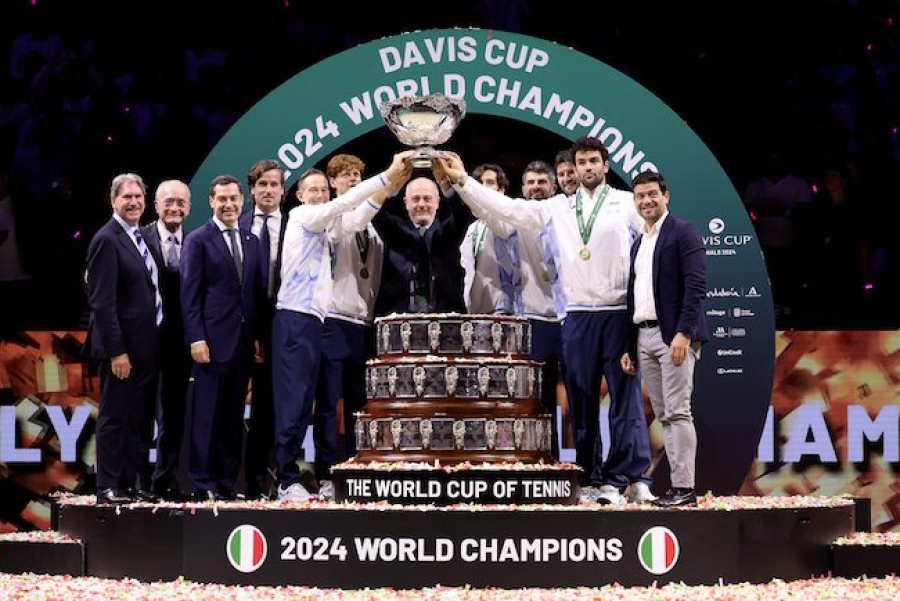
Val Pusteria and Val Gardena incubators of the Sinner phenomenon. Those 2018 words to the Bolzano RAI: ‘I will be number 1’. He takes his teammates by the hand and leads them to the roof of the planet. Drop shot, a touch of poetry in Jannik's progress. The sense of team growing in females and males. The ‘overshadowed’ feat of the girls in the Billie Jean King Cup .
My personal excursus in Alto Adige, or South Tyrol as the locals perhaps still prefer, began in the 1960s with trips, together with my parents, to the Hippodrome of Maia, Merano where a grand prix was run - a gallop - which was also linked to a State Lottery: and my father Rino used to tell the story for the readers of Stadio. At the time, the Passer Promenade was teeming - it was September - with kiosks for traubenkur, or grape juice as a therapeutic remedy: the stuff of 19th-century courts, Merano was truly a timeless place. Later, when I started working too, at the end of the 1970s, the fashion broke out, pushed by the Tourist Promotion Companies, of inviting journalists on ‘educational tours’; the land on the border with Austria, a few decades after the irredentist bombs of Eva Klotz, had plenty of money to invest in tourism.
I remember the shouting of the Bruneck ice hockey ‘ultras’, ‘Fohr, fohr, Bruneck tor’, the discovery of knodl, kaminwurzen, kaiserschmarren and every other good thing, the old men from the villages who, in stunted Italian, urged their children to master it better, a blood bond ‘more with Bavaria than with Austrians’, a frequenter of the stube in Rasun told me, and even a few downhill runs from the lifts at Sesto in Pusteria.
Here, more or less in this Tyrol, the baby of the Sinner family was born. Who could have been No. 147 in the FISI giant slalom ranking (or a good C in mid-football, Ligabue model) and instead, fortunately, chooses to be No. 1 in the world tennis ranking (and the strongest tennis player in Italian history, already, at the age of 23). He exposes all this with great clarity to his colleague Daniele Magagnin, a journalist from Bolzano, after a (partial) failure (who beats him is such a Peter Heller, German, career high 273 in the world) in the Challenger of Santa Cristina in Val Gardena that would have brought him within the top 900 (!) rackets of the globe. It was 18 August 2018. ‘My dream is to become number 1 in the world and to win as many slams,’ he says with apparent self-assurance after saying that his role model is Andreas Seppi (South Tyrolean like him, Italian Daviscupman, number 18 in the ranking in 2013). Then he wins the ITF in Bergamo, publicly thanking the ball boys (he hasn't changed!).
There is also the problem of having appeared too ‘bold’, so much so that he confided to a friend ‘I am not a “braggart”, but simply a person who sets himself a goal’. And it is, I think, the absolute debut in the use of a term that is as much Bolognese as it is Romagnolo, before the tortellini of the mother of his former physiotherapist, the anzolese Jack Naldi (that broth, for so many reasons, is no longer tasted. And it is also sad, but right).
His calmness, his being a silent, thoughtful, affectionate, grateful ‘captain’ made him as great as the variety of strokes he now put together: late arrivals, a deadly drop-shot (what a beautiful English term in the face of the banal ‘short ball’) and a serve, if not of absolute level, at least remarkable. With the fusion of these talents, it was not impossible to predict the encore of the Davis success, nor even the regrowth of Matteo Berrettini, a doubles player of good calibre, better than Jannik (doubles is not the sum of two singles players, it is worth remembering), but above all the bearer of three points out of three matches: a re-boom also the result of the brotherly attention that Sinner dedicated to him. And patience if the fragile Musetti of the first day in Malaga was not able to redeem himself or the solidity of the Bolelli-Vavassori doubles was not allowed to show itself. The ‘manager’ Volandri did not - almost - miss a beat.
If possible, the girls did a much more titanic feat in the Billie Jean King Cup. There was no number 1, there was no precedent (ok, there was, but far in time and, Errani aside, with other protagonists), there were no ‘Sinner-like’ exploits in the circuit. And yet Bronzetti's promotion to number two of the Italian team, bypassing the more titled Cocciaretto, the great combativeness of Paolini, still number four in the world, the team sense of Sara Errani and the great calmness of the non-playing captain ‘Tax’ Garbin hit the mark. The only pity is that the big TV media did not believe it, but the girls, third in the world ranking, have made that upgrade, which is mainly the result of an untouchable group like cement.
The racket, in the world, speaks Italian. For the sporting world, this is an unspeakable satisfaction. The group sense of the men's and women's teams is superior to that of Cucelli/Del Bello 1 and 2 (immediate post-war period), Pietrangeli/Sirola/Tacchini/Gardini/Merlo (1960s), Panatta/Bertolucci/Barazzutti/Zugarelli (Chile ‘76) and Vinci/Errani/Pennetta/Schiavone (Fed Cup 2013). The new generations will have many faults but, being made up of more normal, less original, not at all crazy, perhaps over-formed people, they have less trouble getting behind the flag. I am optimistic.
Why? I want to tell you a secret: it is not over.