Panathlon International (PI) participated in the Annual Conference of IPACS (International Partnership Against Corruption in Sport), held on 23 October 2025, dedicated to progress in the fight against corruption and the promotion of good governance in sport.
During the meeting, the 2025 activity reports of the two IPACS Task Forces — Good Governance and Cooperation between Criminal Justice Authorities and Sports Organisations — were presented, together with the new IPACS Roadmap 2026.
Good governance and transparency
The Good Governance Task Force launched the “IPACS Sport Governance Benchmark & Guidelines Handbook”, a simplified version of the international model for ethical and responsible management of sports organisations.
The handbook, which is the result of collaboration between governments, sports organisations and international bodies, offers practical recommendations on issues such as conflict of interest, gender equality and managerial responsibility.
Throughout the year, the Task Force promoted awareness-raising and training activities, including online workshops and an event in Athens, organised with the Council of Europe and the Hellenic Olympic Committee, which led to the latter joining IPACS.
Synergies between justice and sport
The Task Force on Cooperation with Judicial Authorities, led by UNODC and the IOC, continued its work to improve international cooperation in the fight against corruption.
Key results included the preparation of a legislative guide on the prosecution of sports corruption cases and an international webinar involving 125 prosecutors from 60 countries.
Panathlon International's commitment
Through its participation, Panathlon International confirms its commitment to promoting ethical values and transparency in sport, in line with IPACS's mission.
PI will continue to support dialogue and cooperation between institutions for an increasingly honest and responsible sporting environment.
On 14 October 2025, the first webinar of the joint European Union - Council of Europe project entitled ‘Training and development of Para sport coaches, referees and managers’ took place, as part of the initiative ‘Sport For All: Promoting Inclusion and Combating Discrimination Against Persons with Disabilities’.
Alexandros Brousiakis, representative of Panathlon International, attended the meeting as an observer and drew up a detailed report on the content discussed.
The ‘Sport For All’ project (March 2025 - August 2026) aims to promote a more inclusive sports culture by combating discrimination and barriers that still limit the participation of people with disabilities and encouraging welcoming and safe sports environments for all.
The official project page can be found at the following link: https://pjp-eu.coe.int/en/web/sport-for-all
The webinar, held in English, brought together researchers, institutional representatives, international organisations, sports federations and grassroots operators – including coaches, referees and managers – to share experiences and good practices, present research and discuss how to bridge the gap between policies and local realities.
The official project page can be found at the following link: https://pjp-eu.coe.int/en/web/sport-for-all
The webinar, held in English, brought together researchers, institutional representatives, international organisations, sports federations and grassroots operators – including coaches, referees and managers – to share experiences and good practices, present research and discuss how to bridge the gap between policies and local realities.
The proceedings were opened by Stanislas Frossard, Head of the Sport Division and Executive Secretary of EPAS at the Council of Europe, who recalled that sport must be “ethical, inclusive and safe, not only in words but also in deeds”.
Among the most significant speeches were those by Philipp Müller-Wirth (UNESCO), Apolline Poas (triathlon referee), Allan Dineen (University of Limerick), Miroslaw Krogulec (Special Olympics Europe Eurasia), Päivi Tolppanen (Finnish Paralympic Committee) and Ivo Quendera (European Paralympic Committee).
All emphasised the need to invest in training and networking to make sport increasingly inclusive, accessible and respectful of diversity.
As Alexandros Brousiakis' report shows, the meeting highlighted the importance of strengthening the link between political and institutional commitment and everyday practices, promoting cooperation between grassroots sports organisations and international bodies.
A message that resonates deeply with the values of Panathlon International, which has always promoted inclusion and respect in sport.
On Monday, October 20, the first meeting of the Erasmus project “MindFit VR: Immersive Sports for Mental Well-being” was held.
Panathlon International was represented by Fabio Figueiras and Monica Rossi, while President Giorgio Chinellato and the Secretary General were in Mexico attending the Pan American Congress.
During the meeting, together with Aladdin Alrifai (Budapest Association for International Sports) and Ilknur Dinç (Deneyimsel Egitim Merkezi Dernegi – Turkey), the next step was defined: the kick-off meeting in Budapest, scheduled for November 2025.
The “MindFit VR” project combines sport and virtual reality to promote mental health, inclusion, and well-being among young people across Europe.
On October 21, 2025, the EPAS 2025 Diversity Conference took place — the annual event of the Enlarged Partial Agreement on Sport (EPAS) of the Council of Europe, dedicated to exploring how sport can promote dialogue and cooperation between young and older generations.
Experts and representatives of European sports institutions discussed inclusion, solidarity, and intergenerational collaboration, with panels focusing on youth engagement, active aging, and sport as a bridge between generations.
During the break, there was also a “walking football” demonstration organized by the Collectivité européenne d’Alsace and the Alsace Football District.
Several best practice projects were presented, and among the speakers and moderators were high-level athletes and former athletes.
Representing Panathlon International, Debora Quercioli and Alexandros Brousiakis participated online.
Once again this year, Panathlon International took part in the CSIT Congress – International Workers and Amateurs in Sports Confederation, renewing the collaboration that has linked the two organisations for years in promoting the ethical and cultural values of sport.
The President of Panathlon International, Giorgio Chinellato, and Past President Pierre Zappelli were unable to attend the award ceremony as they were busy in Mexico, where the Pan American Congress of Panathlon International was taking place at the same time.
Claudio Muccioli, President of Panathlon Club San Marino, officially represented the Association and presented the Panathlon CSIT WSG 2025 Award, accompanied by Past President Leo Achilli.
The award, established in collaboration between CSIT and Panathlon International, is intended for those persons who, through their commitment and example, have contributed to spreading the sporting ideal, promoting fairness, respect and solidarity through sport.
For the 2025 edition, the award was presented to Elisabeth Speiser, President of the ICSBF – International Catch'n Serve Ball Sports Federation, a leading figure in the international sports scene. Under her leadership, the ICSBF has developed and promoted an innovative and inclusive discipline, Catch'n Serve Ball, which encourages the participation of athletes of all ages and abilities, focusing on fair play, socialising and cooperation among participants.
Through her tireless work, Elisabeth Speiser has fully embodied the principles shared by Panathlon International and CSIT: sport as a tool for education, friendship and social progress.
In previous years, the Panathlon CSIT WSG Award has been presented to prominent figures such as Prof. Kalevi Olin, Honorary President of CSIT, and Avi Sagi, both of whom were honoured at the closing ceremonies by representatives of Panathlon International, led at the time by Past President Pierre Zappelli.
With this new edition, Panathlon International renews its commitment alongside CSIT to support and celebrate those who, through sport, promote the universal values of humanity, integrity and inclusion.
On Sunday, 26 October, starting at 2 p.m., Panathlon International will be present at RelazionExpo to talk about how sport can be a real tool for growth, inclusion and social responsibility.
The meeting will be an opportunity to share ideas, experiences and concrete projects through the voices of our journalist members and experts, as well as partners involved in the fields of sport, culture and sustainability.
It will be a moment of dialogue and discussion to reflect on the values that make sport a true school of life: capable of uniting people and communities, inspiring respect, passion and commitment to the common good.
FREE ENTRY
Registration required at: https://www.relazionexpo.com/
Saturday, 18 October 2025
The proceedings held in the city of Chihuahua, Mexico, have come to an end after two days of intense work and high-level speeches addressing an important issue that is very close to the heart of Panathlon International: the protection of children's rights in sport.
The Congress was opened by the President of the Club Delicias, Armida Guadalupe Sonia Meraz, and the President of the District Mexico, Coco Samaniego.
After speeches by International President Giorgio Chinellato, who presented the activities and projects of PI, and Secretary General Simona Callo, who illustrated the activities of the General Secretariat, there were numerous speakers and District Presidents from almost all the South American and American Districts and Clubs: Argentina, Brazil, Colombia, Chile, Mexico and Uruguay. They presented their reports and the projects they are carrying out in their territories with great interest and involvement from those present.
The participants also followed with interest the reports presented by the President of CREC, Antonio Bramante, and the President of the Belgian District, Paul Standaert.
Also present were the Vice President of PI Luigi Innocenzi, Past President Pierre Zappelli, International Board Member Carlos De Leon, together with Francesco Silvi, Board Member of the Italian District, and Jean Pierre Largo of the Panathlon Club Fribourg.
The proceedings concluded with a big thank you to the Club Delicias, the President of the District Mexico, Coco Samaniego, and all those who worked and participated in the realisation of this event and welcomed the participants with great Panathletic spirit and friendship.
The reading of the FINAL RESOLUTION concluded the 16th Pan American Congress, setting the date for the next Pan American Congress to be held in Chile in 2027.
Declaration of the 16th Pan American Congress Chihuahua Mexico 2025
15-19 October 2025 - The 16th Pan American Congress of Panathlon International has begun in Chihuahua, Mexico, with the central theme ‘La Importancia del Deporte en la Niñez’ (The Importance of Sport in Childhood).
The Congress was opened by the President of the Mexico District, Socorro Samaniego, and the President of the Delicias Club, Armida Guadalupe Sonia Meraz.
During the opening ceremony, the Secretary General of Pi, Simona Callo, presented the report on the work of the Secretariat, followed by the report of the International President, Giorgio Chinellato, on the activities of Panathlon International.

During the webinar “The Importance of Referees in Sport”, organized on October 9 by the Culture, Research and Education Commission of Panathlon International, chaired by Antonio Bramante, a clear message emerged: referees are not only guardians of the rules, but also custodians of sporting ethics and role models of integrity.
Gwenda Stevens, President of the International Federation for Sports Officials (IFSO), presented the objectives of the Federation, while Professor Paul Wylleman highlighted the psychological and social challenges faced by sport officials — performance pressure, verbal abuse, isolation, and job insecurity. Addressing these issues requires specific mental skills – from stress management to self-confidence – and a holistic support approach that includes physical, psychological, social, and professional dimensions.
From the contribute of Belgium District President Paul Standaert and the introductory message by Panathlon International President Giorgio Chinellato, it emerged that Panathlon International promotes a culture of respect based on education, awareness, and recognition. Its initiatives aim to raise awareness among coaches, parents, and players, to introduce codes of conduct, and to enhance the value of referees through campaigns and training programs.
The final message is powerful:
Respect for referees is the foundation of fair play.
Only through education, empathy, and support can we ensure that those who uphold the rules are themselves respected.


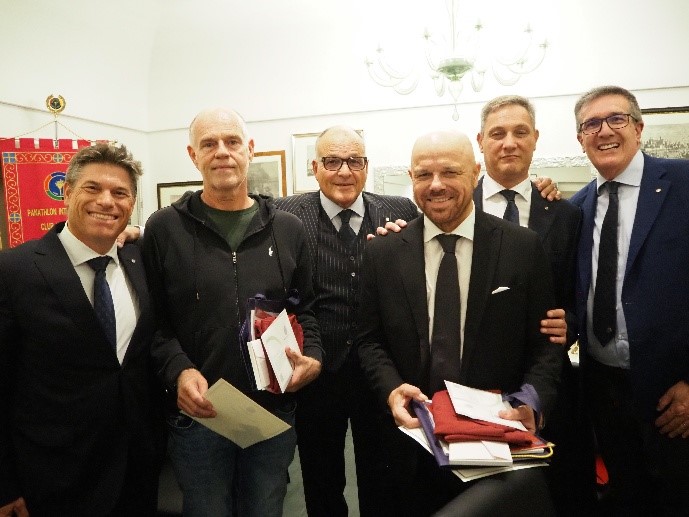
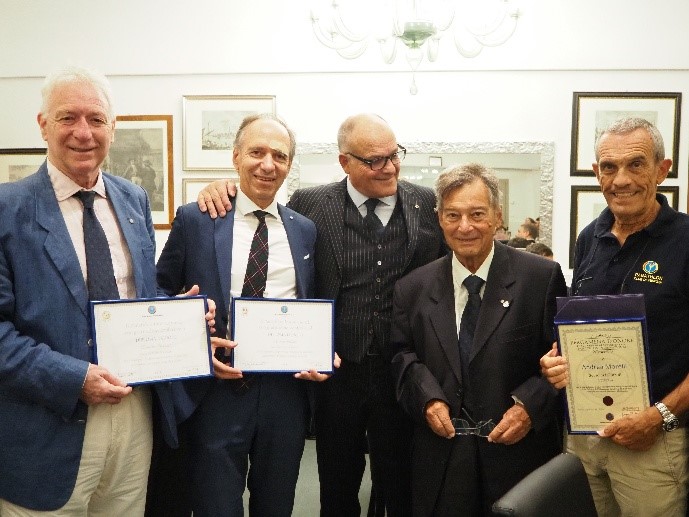
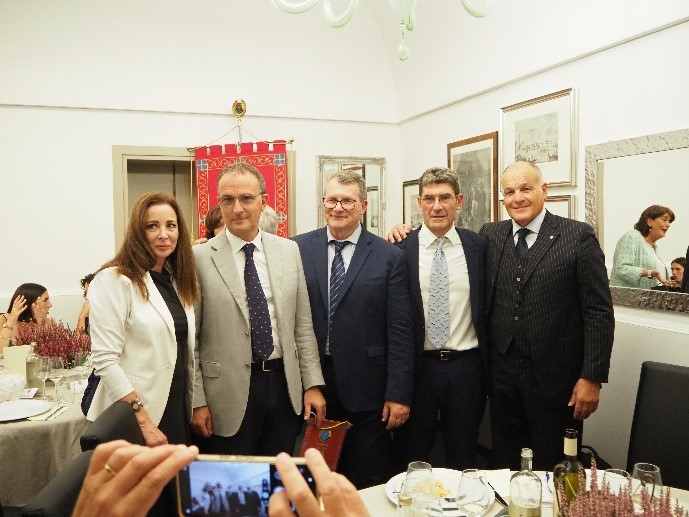
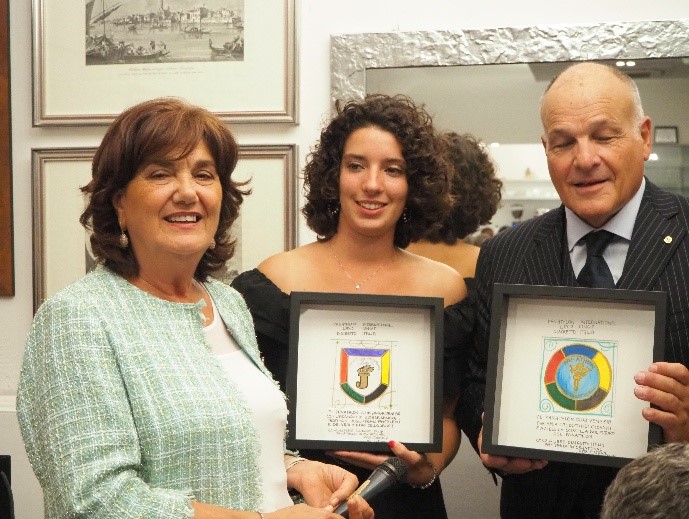
25 September 2025 – An evening full of meaning and strong emotions accompanied the convivial meeting of the Panathlon Club of Venice, during which the Panathlon Club Venice Jr. was officially presented, whose constitution was officially approved by Panathlon International on 4 September.
A particularly touching moment was dedicated to the young members of the new Junior Club, led with enthusiasm, passion and competence by President Veronica Berti. They received congratulations and encouragement from the DI Junior Club Delegate, Rita Custodi, who emphasised the educational, inclusive and innovative value of the project.
Alongside Veronica Berti were Caterina Almansi, Marta Bertoldini, Filippo Carraro, Fabio Cerchiai, Nicolò Darai, Jacopo Pajer, Lorenza Perini and Diego Secchieri. Dario Manente and Angelica Marengo were absent with justification.
The new young Panathletes were welcomed not only by the President and all the members of the Venice Club, but also by Rita Custodi, National Board Member of the Italian Panathlon District with responsibility for Junior Clubs, and Giuseppe Falco, Governor of Panathlon Area 1 - Veneto, Trentino A.A. - Südtirol. The International President, Giorgio Chinellato, was absent due to institutional commitments in Brussels, but was ideally close to the initiative.