










Catherine Debrunner und Floorball Thurgau gewinnen «Thurgauer Sportpreis 2025»
Die Para-Leichtathletin Catherine Debrunner und das Unihockey-Team Floorball Thurgau sind die Gewinner beim «Thurgauer Sportpreis 2025». Sie wurden am Freitagabend im Pentorama in Amriswil ausgezeichnet, wo auch die Eiskunstläuferin Livia Kaiser als „Newcomerin des Jahres» und Ernst Gerber als «Sportförderer des Jahres» geehrt wurden.
Bis am 27. Januar konnte gewählt werden beim «Thurgauer Sportpreis 2025» - am Freitag nun wurden die Sieger gekürt. Moderiert wurde die 45. Feier dieser Art wiederum von TV-Moderator Jann Billeter, der mit grossem Fachwissen die Sportlerinnen und Sportler interviewte.
Panathlon Clube de Lisboa - REUNIÃO DO CONSELHO DE SÓCIOS DOCENTES DO CLUBE
Published in News from Clubs
Com o elevado apoio da @Escola de Direito da Universidade do Minho realizou-se ontem, sábado dia 22, a reunião periódica do Conselho, dirigida pela Coordenadora do Conselho - Professora Carla Chicau Borrego - que contou com a presença dos sócios: Antonino Pereira, Rui Proença Garcia, Luís Horta, Patrícia Sousa Borges, Luís Paulo Relógio, Alexandre Mestre, Daniel Seabra e Lúcio Miguel Correia.
Assistiram os Presidente e Vice-presidente do Clube, Mário Almeida e Fábio Figueiras.
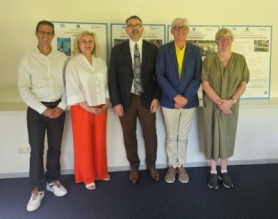
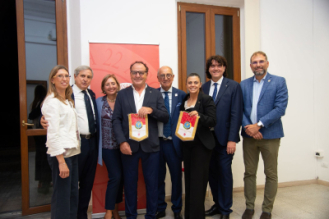
A reunião iniciou-se com a visita e boas vindas da Presidente da Escola de Direito da Universidade do Minho, Profª Drª Cristina Dias (no centro da fotografia) que fez jus em referir o apoio da Escola a esta importante reunião no contexto das linhas de conduta e promoção da Ética pela Escola.
A reunião debateu importantes pontos da estratégia delineada para 2025 nomeadamente a implementação de estruturas técnicas de suporte às grandes áreas de atuação e e a aproximação do anúncio da edição do Ética Summit 2025.
Distrikt Schweiz + Liechtenstein - Au cœur des championnats du monde de biathlon
Published in News from Districts
Le Panathlon Club de Coire avait lancé une invitation et un peu plus de 50 panathloniennes et panathlonniens ont assisté aux Championnats du monde de biathlon à Lenzerheide le mercredi 12 février. Malheureusement, en ce jour d'ouverture, la Suisse a manqué une médaille lors du relais mixte à Lantsch/Lenz, mais les visiteurs ont tout de même vécu une journée inoubliable.
Répartis en quatre groupes, les panathlètes ont eu un aperçu direct de l'organisation des Championnats du monde de biathlon et des subtilités du biathlon. Lors du tir, Selina Gasparin, médaillée d'argent aux Jeux olympiques, a expliqué comment atteindre la petite cible au millimètre près. C
Am Puls der Biathlon frz_Version

The meeting of the President's Committee took place online on 31 January, during which several important topics were discussed for the future of the organisation.
Among the main items on the agenda, the PI's network of international relations with the most important associations involved in the promotion of Fair Play was discussed in depth. In this context, the appointment of Past President Pierre Zappelli as our representative on the CIFP Board was made official.
The cooperation with the ISOH (International Society of Olympic Historians), CIFP (International Fair Play Committee) and CIPC (Pierre De Coubertin International Committee) associations was confirmed. They are among the PI partners in the organisation of a special event in connection with the Paris 2024 Olympic Games. In this context, the date of the meeting between PI delegation and the Director of the IOC Olympic Foundation for Culture and Heritage was also confirmed for 13 March to introduce PI projects.
Ample time was dedicated to Erasmus projects. Fabio Figueiras, delegate for Erasmus projects, illustrated in a report, the opportunities that emerged during the Info Sport Day. Meanwhile, the President of District Belgium, Paul Standaert, together with Yves Vanden Auweele, joined the meeting and updated the Committee on the progress of the MAISI/DAISI project, which has already been approved by PI and further information will be provided to clubs.
Another important initiative was the project, endorsed by PI, suggesting asking UNESCO to proclaim 25 September as International Youth Sport Day for Education and Growth.
In addition to the international cultural activity, the request of some clubs to be able to voluntarily pay the fee proposed by the IB was welcomed, after the negative outcome of the vote on the fee increase during the General Assembly in December.
During the meeting, some delegations were redefined, including those related to Fair Play and PI Charters. The composition of the CCSE (Culture Commission) and the working group dedicated to expansion were confirmed.
The Committee announced, with great satisfaction, the birth of two new clubs: one in Rio de Janeiro (Brazil) and one in Frosinone (Italy), marking an important step forward for the organisation's growth. The issue of printing and translating the official magazine was also discussed as part of a cost containment policy.
The Committee was very pleased to announce the creation of two new clubs, one in Rio de Janeiro (Brazil) and one in Frosinone (Italy), marking an important step forward for the growth of the organization.
Other points were discussed and deliberated. The decisions, once final and translated, will be published as usual in the reserved area of the PI site.
European Fair Play Movement Awards
Published in News from Clubs
The European Fair Play Congress and the General Assembly of the European Fair Play Movement will take place on 19 May this year, in celebration of the World Fair Play Day, established by the UN General Assembly in its resolution A/78/L.85, the EFP/EFPM Awards Ceremony is also scheduled for this day.
EFPM annually invites all its members, European National Olympic Committees, sports organisations and educational institutions to submit their applications to the Fair Play Awards in following categories:
THE EUROPEAN FAIR PLAY PLAQUE OF MERIT AND DIPLOMA, made under the patronage of the European Olympic Committees to an organisation/ an individual
THE EUROPEAN FAIR PLAY DIPLOMA, made under the patronage of the European Olympic Committees to an organisation/ an individual
THE EFPM “SPIRIT OF FAIR PLAY” AWARD to organisations/ teams or individuals
THE EFPM “FAIR PLAY FLAME” AWARD to an athlete or a team under 18
THE EFPM “FAIR PLAY VOX” AWARD, made under the auspices of AIPS Europe for institutions and companies involved with the printed, broadcast or electronic media, and for the people who work in them.
We are certain that despite the short timing you will be able to submit personalities, organisations, projects and campaigns in your area that are worthy of these important awards.
The criteria for each of the Fair Play Awards including the details and nomination forms can be found on the EFPM web section "Awards": www.fairplayeur.com/awards/
Please find attached the Nomination guide 2025 and also the Nomination Form for the different Awards to be filled.
Entries for the 2025 EFP/EFPM Fair Play Awards can be sent to the following e-mail address until April 15, 2025: katarina@fairplayeur.com
Only proposals on the attached form will be accepted.
Panathlon Club Avignon - Trophées du fair play et due mérite aux femmes
Published in News from Clubs
Le Panathlon Club honore les sportives vauclusiennes
Pour la première fois les Jeux olympiques et paralympiques affichaient à Paris une parfaite parité chez les athlètes.
Une bonne raison pour le Panathlon Club d'Avignon de consacrer les Trophées 2024 du Fair-play et du mérite aux femmes .

The black-and-white baskets of Praja Dalipagic, hero of Slavic basketball
Published in News from Panathlon International
by Alberto Bortolotti
The remembrance of Drazen Dalipagic cannot begin except with a kind of basketball homily by the greatest guru of their basketball, the Julian/Slovenian Sergio Tavcar: “... three champions that cannot be discussed were Dragan ‘Cobra’ Kićanović, Dražen ‘Praja’ Dalipagić and Vlade Divac. All of these were players who on the day gave the distinct feeling of being unmarkable, a characteristic that distinguishes the champion from the mere champion. On these players my conviction is of the 'Taucerian' type, that is, absolute.”
Speaking of definitions, in Belgrade Partizan fans used to call them “Kića i Praja, pobede bez kraja” (Kića and Praja, endless victories). And, as for personality, here's-perhaps-an urban legend: the story goes that, at some point during preparation, Dalipagić went to the granite Professor Nikolic, his coach, on behalf of the entire team. “Coach, maybe it would be better if you also listened to what we want. Because you the championship without us will not be able to win it, while we, even without you, could probably still win it.”
As for the 70-point record, I remember well that January 25, 1987, the day of 70 points. I was in the newsroom at Rete 7, waiting to make the full-bodied Sunday “Sport Today,” the sports newscast that could not avoid dealing in depth with Bologna, Fortitudo and Virtus (all playing on Sunday afternoons, the “lunch match” and “football night” were stuff, perhaps, from the NFL). A few weeks earlier we had called MartyByrnes, the algid, off-white foreigner brought in by a somewhat retreating Avvocato Porelli and who would, that Sunday at Arsenal, mark Praja Dalipagic (barring rare, unplanned moments in the zone), a “tristo”: a Bolognese adjective meaning poor. He raged about it but eventually agreed with us, in spite of the treatment that coach Sandro Gamba applied to that rebellious and uncombative outfielder. At the end of the season he was dismissed.
It amazed the scoreboard that said 70 points (the 3-point shot had come just three seasons earlier, but I almost think he would have made that haul anyway!) however, it did not amaze the hail of blows that sunk the black Vs among the Venetian calli. After all, Dalipagic was the one who “chewed up” 600 solo shots at the end of each practice, so much so that he had the custodian give him a copy of the gym keys because he, the Bosnian from Mostar when Bosnia-Herzegovina was still perhaps a region of the Titino empire, wanted to exercise the basically peculiar characteristic of basket ball: the basket, indeed. It's called “basket ball,” this sport, I often remind my friend Ettore Messina of it, too. And of the deep essence of that sport Dalipagic was probably the most faithful, attentive interpreter, a kind of guardian of the Holy Grail: the shot, in its absolutism and in its technical and stylistic purity. A living manual.
In 1987 Praja had just retired from the “plavi” national team, which then defunct, as an entity, in '91 in Rome when Slovenia came out first from Yugoslavia and Jure Zdovc was removed, as if he were a thief, from the Capitoline retreat. His generation predates the glittering generation that so many remember: the Petrovic, Kukoc, Radja, Savic, Divac, Danilovic, Djordjevic, and 100 others we could name.
All I know is that, for us high schoolers discovering color on TV and irreverent commentaries from Koper/Capodistria, almost always with the unmistakable voice of Sergio Tavcar, there was a trimurti. The Three Gods of the time were Mirza Delibasic, point guard, DraganKicanovic, guard, Drazen Dalipagic, wing.
Ah, if you don't believe in the possibility of 70 points “without 3-point shooting,” read this Udinese anecdote. 46 points, then the next week 50, “without 3 point line.” But let's go in order.
During one of the shooting sessions the young assistant coach Colosetti had occasion to tell the champion from Mostar that before him he had known and coached one of his peers, Walter Szczerbiak.
“In a shooting session with Praja I told him that I had worked with another great shooter in Udine: Walter.” Lapidary was the response of the astonished Dalipagic: “Yes, great hand, but I am more complete because I also play one-on-one and create my own shot.”
The coach again: “Drazen took us to A1 by winning the top scorer title and scoring 46 points against Perugia and 50 against Reggio Emilia in the last two decisive games, when there was still no three-point shooting and he was already 32. Forty years ago, the career did not last as it does now until almost forty years of age. Five or six years earlier Dalipagic was at his peak, when he was winning World Championships and Olympics he was infeasible. He was in the prime of athletic vigor at 27 or 28, while at 32 he was playing technique in shooting. He was not a great defender, but, when stimulated, he also defended.”
Translated with DeepL.com

The M.A. Olympic Studies is a fully accredited, 120-credit master’s program designed for professionals who wish to continue working while pursuing their studies. This part-time program includes one intensive study week per semester, covering six modules that explore both theoretical and practical aspects of the Olympic Movement. Topics include Media and Commercialization, Sports Policies, and International Relations.
For more information and to apply, please visit the following application website: https://myspoho.dshs-koeln.de/qisserver/pages/cs/sys/portal/hisinoneStartPage.faces and a tutorial video to help applicants throughout the process. For further questions please reach out to j.deszatnik@dshs-koeln.de
General Overview
The programme implements a high-level, interdisciplinary curriculum in Olympic Studies to foster the links between the academic and the Olympic world. There are in total 6 Modules, which cover both the theoretical and practical framework of the Olympic Movement:
1. Ethics, Values and Olympic Education
2. Olympic Athletes and Elite Sport in Transition
3. Research Methodologies in Olympic Studies
4. Governance, Policy and Olympic Organizations
5. Olympic Games – Media and Commercialization
6. International Relations and the Olympic Movement
Funding opportunities for our program are provided through the Olympic Solidarity Scholarship Programme, in collaboration with the respective National Olympic Committees (NOCs), not directly by us.
The application period remains open until February 28 2025.
Sara Piffer, young promise of cycling has left us at the age of 19
Published in News from Panathlon International
She is the 425th victim in the last two years: a massacre for cyclists.
by Matteo Contessa
She was born in a land of cyclists, Sara Piffer, the young Trentine two-wheeler promise who was run over and killed by a car on Friday on the Rotaliana internal road connecting Mezzocorona and Mezzolombardo. She was born in Palù di Giovo, the village of Francesco Moser, to name but one. And in that land of cyclists she left forever. Soon. Too soon. Because at 19, whatever the cause, it is still too early to die. She was a competitor, Sara, and was training with her brother. She had started her career with Velo Sport Mezzocorona and had distinguished herself with a second place in the Madison in 2021. With the Mendelspeck Ge-Man, she had won last year in Corridonia, Marche, and had finished second in the Trentino time trial in Verla/Maso Roncador.
The motorist who hit her, a 70-year-old gentleman, explained that he was overtaking, but was dazzled by the sun and did not see the two boys coming in the opposite direction. He thought he was giving himself an extenuating circumstance with this explanation. Instead, he threw an aggravating circumstance at himself: on that stretch of road the carriageway is not wide and overtaking another car was already a borderline manoeuvre. If there was also the sun glaring down, making it impossible to see whether someone was coming in the opposite direction, then one had to wait until one had a full and clear view before initiating the manoeuvre.
Sara Piffer is not the number 9 cyclist in 2025 to lose her life. No, Sara is number 425 in the last 24 months. A carnage. Which didn't actually start at the beginning of 2023, it has been going on for a long time before that if we think that Michele Scarponi, along with Davide Rebellin undoubtedly the most illustrious victim on this list, was mowed down while training near his home in the Marche region in April 2017. Many cyclists are run over just like Sara Piffer, because they are unobtrusive figures in the roadway and ride at the edge of it. Those behind the wheel always think they have enough space to pass anyway. Instead, the space is often not there and those who are less stable always pay the consequences. And these are almost always competitive cyclists, because they are the ones who need long, evenly surfaced roads to train. They therefore ride on arterial roads frequented by mixed traffic. Cycle tourists, on the other hand, use the increasingly extensive and widespread network of cycle paths closed to motor vehicles for their outings
In both cases, those who ride on two wheels must observe very strict safety rules: helmet compulsory, front and rear lights always on, riding in single file and as close to the edge of the road as possible, fluorescent clothing and reflectors at various points on the bike to be visible from a distance even in poor visibility. But this is often not enough. The Italian Highway Code, already in its version prior to the current one, stipulated that there must be a distance of one and a half metres between the motor vehicle and the bicycle when overtaking. But almost never is this distance respected. Then there are accidents, injuries and deaths.
Something must be done to stop this carnage. But it is no longer just a question of written rules. It is a cultural issue, because the cyclist on the road cannot be considered the child of a lesser god by motorists. Everyone must do their part. And Panathlon International, which has numerous cyclist groups in different parts of the world, is certainly not backing down. Memoranda of understanding, even at national level, are important to make cycling safer. But they alone are not enough if a different culture is not promoted among those who use the roads by different means.
More is also needed. A very good idea has been making the rounds for some time now, and it was while commenting on Sara Piffer's death that Gazzetta dello Sport journalist Luca Gialanella gave it a strong voice: we need to start with driving school courses, including the study of the rules of engagement between motor vehicles and bicycles in the textbooks preparing for the licence and above all in the compulsory practical driving training for those who want to take it. This would be the right start to educating new generations of drivers to think of the roads as a place where four and two wheels can coexist.
In the meantime, Panathlon International's thoughts go out to those left behind: to her family members and in particular to Sara's brother who used to ride with her and will no longer be able to ride a bicycle. The pain is heartbreaking. And all of us cannot just be spectators to this carnage. In Italy and outside Italy.
(Translated with DeepL.com)

The General Secretariat's offices will be closed on Monday afternoon 27 January due to hydrogeological alert (orange from 3pm to 6pm) and Tuesday 28 January due to red alert (until 2pm) and orange alert (until 4pm)
